CHAPTER V – The Adventure of Reason
It is for the same reason that we shall here use the plant for introducing Goethe’s method. The following exposition, however, does not aim at rendering in detail Goethe’s own botanical researches, expounded by him in two extensive essays, Morphology and The Metamorphosis of Plants, as well as in a series of smaller writings. There are several excellent translations of the chief paper, the Metamorphosis, from which the English-speaking reader can derive sufficient insight into Goethe’s way of expressing his ideas; a pleasure as well as a profit which he should not deny himself.
Our own way of procedure will have to be such that Goethe’s method, and its fruitfulness for the general advance of science, come as clearly as possible into view.3 Botanical details will be referred to only as far as seems necessary for this purpose.
The data for observation, from which in Goethe’s own fashion we shall start, have been selected as best for our purpose, quite independently of the data used by Goethe himself. Our choice was determined by the material available when these pages were being written. The reader is free to supplement our studies by his own observation of other plants.
*
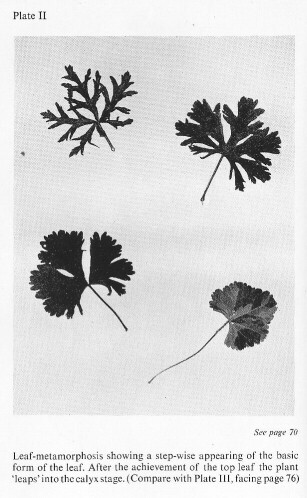
Plate II
Plates II and III show two series of leaves which are so arranged as to represent definite stages in the growth-process of the plant concerned. In each sequence shown the leaves have been taken from a single plant, in which each leaf-form was repeated, perhaps several times, before it passed over into the next stage. The leaves on Plate II come from a Sidalcea (of the mallow family), those on Plate III from a Delphinium. We will describe the forms in sequence, so that we may grasp as clearly as possible the transition from one to another as presented to the eye.
Starting with the right-hand leaf at the bottom of Plate II, we let our eye and mind be impressed by its characteristic form, seeking to take hold of the pattern after which it is shaped. Its edge bears numerous incisions of varying depths which, however, do not disturb the roundness of the leaf as a whole. If we re-create in our imagination the ‘becoming’ of such a leaf, that is, its gradual growth in all directions, we receive an impression of these incisions as ‘negative’ forms, because, at the points where they occur, the multiplication of the cells resulting from the general growth has been retarded. We observe that this holding back follows a certain order.
We now proceed to the next leaf on the same plate and observe that, whilst the initial plan is faithfully maintained, the ratio between the positive and negative forms has changed. A number of incisions, hardly yet indicated in the first leaf, have become quite conspicuous. The leaf begins to look as if it were breaking up into a number of subdivisions.
In the next leaf we find this process still further advanced. The large incisions have almost reached the centre, while a number of smaller ones at the periphery have also grown deeper into the leaf. The basic plan of the total leaf is still maintained, but the negative forms have so far got the upper hand that the original roundness is no longer obvious.
The last leaf shows the process in its extreme degree. As we glance back and along the whole series of development, we recognize that the form of the last leaf is already indicated in that of the first. It appears as if the form has gradually come to the fore through certain forces which have increasingly prevented the leaf from filling in the whole of its ground-plan with matter. In the last leaf the common plan is still visible in the distribution of the veins, but the fleshy part of the leaf has become restricted to narrow strips along these veins.
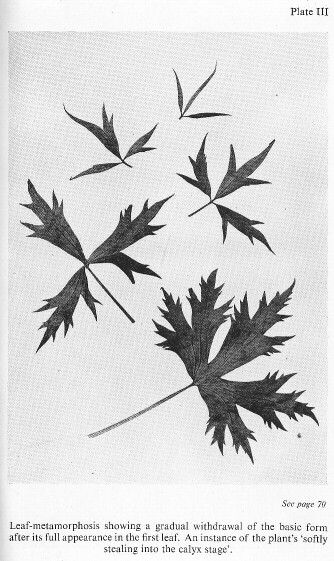
Plate III
The metamorphosis of the delphinium leaf (Plate III) is of a different character. Here the plant begins with a highly elaborate form of the leaf, while in the end nothing remains but the barest indication of it. The impression received from this series of leaves is that of a gradual withdrawal of the magnificent form, revealed in its fullness only in the first leaf.
A more intense impression of what these metamorphoses actually mean is achieved by altering our mode of contemplation in the following way. After repeated and careful observation of the different forms on either of the plates, we build up inwardly, as a memory picture, the shape of the first leaf, and then transform this mental image successively into the images of the ensuing forms until we reach the final stage. The same process can also be tried retrogressively, and so repeated forward and backward.
This is how Goethe studied the doing of the plant, and it is by this method that he discovered the spiritual principle of all plant life, and succeeded also in throwing a first light on the inner life-principle of animals.
*
We chose the transformation of leaf forms into one another as the starting-point of our observations, because the principle of metamorphosis appears here in a most conspicuous manner. This principle, however, is not confined to this part of the plant’s organism. In fact, all the different organs which the plant produces within its life cycle – foliage, calyx, corolla, organs of fertilization, fruit and seed – are metamorphoses of one and the same organ.
Man has long learnt to make use of this law of metamorphosis in the plant for what is called doubling the flower of a certain species. Such a flower crowds many additional petals within its original circle, and these petals are nothing but metamorphosed stamens; this, for instance, is the difference between the wild and the cultivated rose. The multitude of petals in the latter is obtained by the transformation of a number of the former’s innumerable stamens. (Note the intermediate stages between the two, often found inside the flower of such plants.)