IRON ROD OF MARS
Chromium is well known as a plating to protect other metals, and is also used in tanning and as a valuable mordant in dyeing wool and silk. Platinum, like nickel, is non-corrosive and is described by Hauschka as being the ‘most dead’ of the iron related metals. Its value, apart from its use in expensive jewellery where it is called ‘white gold,’ is that of a crucial catalyst in industry. Being ‘dead’ itself it remains unchanged while initiating or speeding up chemical reactions.
THE METEORIC IRON SPIRAL
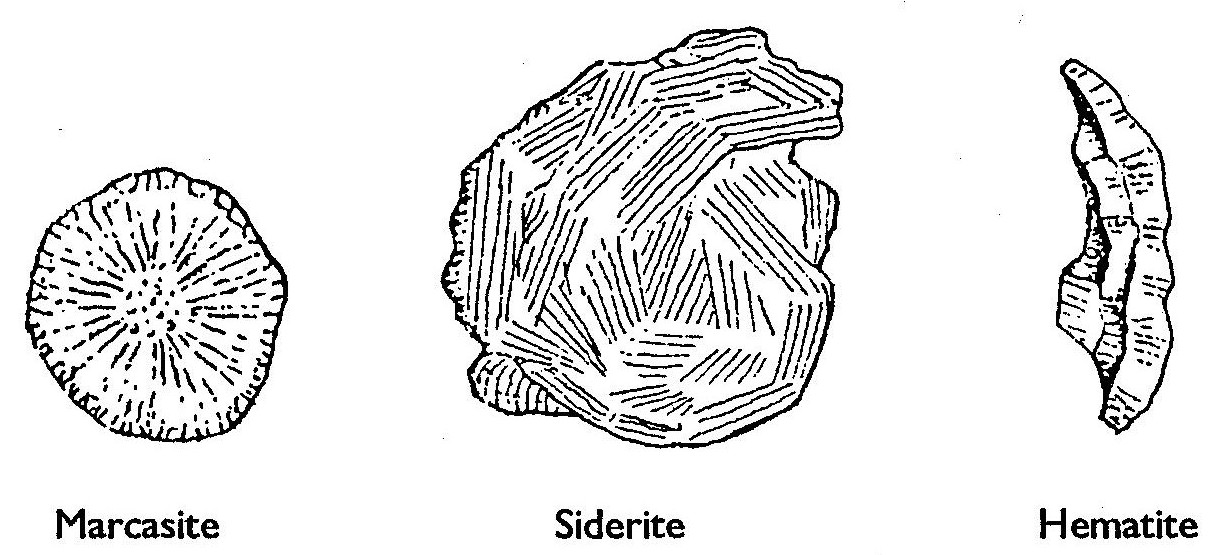
As mentioned before, there is a large variety of iron ores and they all show a great diversity in their crystalline formation, but two distinct patterns stand out above the others; aradial tendency seen in marcasite, and a spherical arrangement seen for instance, in the ore hematite. When these two dynamics, the radial and the spherical combine we see an obvious spiral pattern emerging, which shows up in the ore siderite.
“The spiral tendency always arises when time enters space and develops towards a centre,” Hauschka writes in his illuminating book The Nature of Substance. ‘ ‘The fact that this dynamic shows up so clearly in iron ores points to the fundamental role played by the iron process, for it transforms spherical forces quite unrelated to the laws of earth into radial forces working towards a centre. One can say that the function of iron is to help cosmic, weightless elements to enter the sphere of gravity.”2
 These cosmic elements include vast quantities of pure meteoric iron dust which shower onto the earth continuously, an estimated several millions of tons a year. Some of this invisible iron naturally precipitates in snow giving rise to the saying that’ ‘snow is the poor man’s fertilizer.” Most frequent in the autumn, these meteoric showers are said to radiate from the constellation of Scorpio, the astrological sign which is coincidentally ruled by Mars.
Hauschka goes on to say: “Iron is the only substance which makes visible in an archetypal picture the incarnating force during its spiral descent, for the path followed by meteors is indeed a spiral, the result of interacting radial and spherical forces.”
George Washington (not the president) in The Zodiac and the Salts of Salvation, also refers to this process when he describes the “watery ether above” filled with the smallest particles of iron, without which’ ‘there would be no means whereby ether could penetrate either into man’s body or the body of the earth.”3
THE “BREATHER OF THE METALS”
As a miniature replica of the earth and the cosmos above, we find iron playing a major role in the microcosm of the human body, permeating the bloodstream and oxygenating the blood. Rhythmically with every breath, we take oxygen from the air into our lungs where it chemically combines with the iron or Ferrum Phos. to give us our red blood. From the lungs via the heart where all the blood in the body passes every three minutes or so, oxygen is carried throughout the system. ‘ ‘The amount of oxygen we are able to absorb into our bodies from the air we breathe depends entirely upon the amount of iron present in the blood to combine with it and carry it to every extremity of the body.”4
As we breathe, the presence of iron permeates our system with the energy and rhythm of Mars, giving us life and reflecting the wider, measured orbit of this planet which swings with its own eccentric rhythm close to and then widely away from Earth.
Just as the smith works externally on the forging iron, so internally our bodies are a kind of furnace with our lungs as the bellows and the iron kindling the fire of chemical reaction with oxygen, renewing the cells and giving the energy for life. But plants too are equally dependent upon iron where it acts as a catalyst for chlorophyll formation. Although iron directly enters the haemoglobin in the blood, it does not enter into the chlorophyll, rather it is manganese (one of iron’s ‘brothers’) which enters the chlorophyll. Pelikan observes that “chlorophyll and haemoglobin are so completely attuned to each other that they maintain the air in perfect equilibrium between oxygen and carbon dioxide (whatever the plant takes from the air is given back by the animal, and vice versa), and that the two breathing substances are so similarly constructed.”5
Whereas water creatures that breathe with copper tend to be almost amorphous in shape, the red-blooded breathers of iron display a far more highly defined form and will for individualized action.
THE IRON REMEDY
When we are deficient in iron the blood is anemic and pale, the Mars will and energy is lacking and there is a general sense of being ungrounded and unable to act with decisiveness. When there is insufficient iron in the blood the circulation is increased to take enough oxygen to all parts of the body, and this increased motion causes friction, which in turn results in heat. In the body this manifests as fever, or inflammation.
So homeopathically Ferrum Phosphoricum is indicated for these symptoms of heating, for hemorrhages and injuries, congestion, depression, lung problems, in fact, all sickness calls for increased oxygen (and therefore iron) to detoxify the system. I have found it to be very effective taken in the first stages of colds and febrile illnesses.
When cast iron pans were used for cooking, a deficiency of iron was relatively rarer than it is today with steel and aluminum (poison!) cookware. But the level of iron in the body can be boosted with green leafy vegetables and herbs, vervain and particularly stinging nettle which has a remarkably high iron content. It was once widely used as a spring tonic after cooking neutralized the poison in the young green leaves. Natural scientist Lilly Kolisko shared Rudolf Steiner’s enthusiasm for this plant in agriculture, writing:’ “The stinging nettle regulates the iron household in nature,” when there is too much iron in the soil nettles can be planted to attract the superfluous iron away from the other plants. Kolisko also discovered that nettles help to regulate the nitrogen in compost heaps when added in homeopathic doses.6