SILVER – Metal of the Moon
‘‘The silver acts in such away that is represents what lives in the light, it produces pictures of what acts in the light. And if we find that this is connected especially with the moon, it may be justified to say: the silver behaves like the moon in the cosmos. The moon itself has the strange quality that it continually reflects the light, which comes from the sun and all the other planets. The moon is the great photographer of the universe, it continually brings us back pictures.”2
Exposing silver salt solution to the sun during the day and the moon forces at night, a continual metamorphosis of forms revealed itself in a rhythmic way, each month with its own ‘signature.’ The Koliskos describe this as a “kind of archetypal photograph made by the silver alone… influences which pass through the universe, which we are unable to observe with our eyes, show themselves through such a substance as silver. So we find the silver, as a metal, representing the formative force of the various seasons, the various moon phases.”
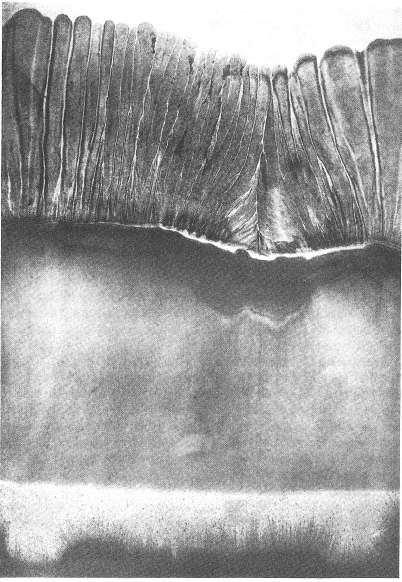
This photograph, taken June 30,1927, describes the crystallization patterns of 1% silver nitrate solution. During the day the silver fl uid rises on the filter paper to its maximum height (see arrow A). At night the fluid rises above the first boundary to form a second delicate picture of the silver forces, and a second boundary (arrow B). During the time of the eclipse this characteristic feathery pattern of silver was temporarily thrown into chaos, but reestablished itself the following day. From: Workings of line Stars in Earthly Substance, Lilly Kolisko, 1928
Rudolf Hauschka, another scientist who studied the work of Steiner, describes the Liesegang ring phenomena—when a drop of silver nitrate falls on a glass plate coated with chrome gelatin, the silver chromate spreads out in a wave motion, a rhythmic repetition that forms concentric spheres. ‘ ‘Ceaseless repetition and wave-like reproduction of some motion or condition of matter are characteristic of the silver force… There is an outflowing motion with a rhythmical wave impulse, like the spread of a musically vibrating sound. This is another example of the kinship between chemical forces and music; the chemistry of a substance is like an inner music that organizes matter into ordered patterns.”3
Silver is like a dense form of moonlight, very like the moon in its brilliance and perfect reflecting power, unrivaled by any other metal. Silver reflects the light shining on it undimmed and almost unchanged; most mirrors today are made by coating glass with a fine layer of silver, so it’s not surprising that lakes of still water reflecting the moon goddess used to be called Diana’s mirror. In fact in the old chemistry, Diana was the name for silver.
Most silver on the planet is found in seawater, although in an attenuated solution, in a ratio of 10 mg. to a cubic metre. Hauschka writes: “It may be that silver acts as a focus for lunar influences, and as a medium for transmitting moon forces and their rhythms to the tides. And just as seawater rises and falls in accordance with the laws of lunar rhythm, so is there a tide of sap in plants.”3
Through the Koliskos’ and Hauschka’s work we find that the moon’s sphere of influence is observed to be very much larger than the physical moon itself. The moon’s law of rhythm extends to all liquids, from the sea to the rising sap, to the reproductive cycle of humans, particularly evident in woman’s menstrual cycle.
SEX, SILVER AND THE MOON
All living organisms are influenced by the moon, the organic liquids are inscribed with the moon’s rhythm. Within the human body the processes of reproduction and renewal take place chiefly in the blood, the inner secretions and fluids bear the lunar character and their sphere of influence is distributed over the whole organism.
Just as the silver reaction in the Liesegang rings spreads in concentric circles, “nature brings forth cycle after cycle of budding, germinating life, as species reproduce their kind…These silver forces are active in all growth and body-building processes in the human organism, and most strongly, of course, where physical life is reproduced: in the sexual organs.”
But the silver force also works on a higher plane in the brain, where thoughts are reproduced and where the world is mirrored in the conceptual life of the human. Curiously enough it is a silver dye which anatomists use to make the brain substance visible. As the Koliskos point out: “The silver enters the substance of the brain, which is penetrated by fatlike substances, lipoids, it enters the organ to which it belongs. It is the silver which dyes the ‘moon organ,’ that is, the brain. The brain, which is spiritually the most reproductive organ corresponds to the moon outside.”2
The brain itself floats in liquid, and is connected with all the other parts of the body, mirroring in miniature the complex network of subtle energies which permeate the entire organism, and reflecting the spiritual force of reproduction.
The knowledge of this dual quality of the moon was well established in the ancient lunar religions where the Goddess ruled the cycles of the moon and the various vegetative and reproductive processes in the human and in nature. Each day of the moon’s cycle was related in a complex science to the secretion of hormones in the body — especially the body of the priestess.
The rites performed in the light of the full moon celebrated the” forces of emergent life streaming down to earth.” In Greek mythology for example, the reproductive power of Diana the many-breasted, was invoked to ensure fertility, to give life to form. But Diana, or Artemis, was also a virgin goddess and in this aspect rather than being physically fertile, her power of creativity is psychic and spiritual and is intensified at the phase of the new moon.