Darrell Butcher – Discovering his Concepts

Upright Treatment Instrument
I have no notes from Butcher on this instrument, but it no doubt follows a pattern similar to his Meter and Pegotty. I can therefore only give a description and measurements.
I begin with the front panel. This consists of a black perspex plate 8″ square, with nine dials and marked with rings of dots in white paint. There are also adjustable dials which have a ‘nitch’ cut out of the side at one point. The outer ring of dots is permanently visible. The inner ring can only be seen by turning the dial until the ‘nitch’ reaches the appropriate point on the panel. A small hole is also drilled in the panel at 45° from horizontal of each dial. The dots are not equidistant.
Total height with base … 26cm, width … 24.5cm.
On the back of the black panel we have a transparent plate IVz” x 7%” on which are glued, for each dial, a circle of black paper 5″ diameter with a cut-out of an Archimedian Spiral in its centre. Over this is a black perspex disc cut with a slit 1cm wide from the edge and almost to the centre. This is adjustable from the front. Finally there is a white disc 4.5cm.
 Why did Butcher go to such endless trouble with this instrument, and what was in his mind when he designed it? This was the conundrum I had to answer. I felt that it might well lie in the two sets of dots. Maybe there was some link between them? This proved to be a false trail. So I then made a sketch of the rings of dots and tried drawing lines between any two points. This took a long time because I was still using both rings. This too proved worthless. I made a final effort, but this time using the inner and outer circles separately, and the result, with diagonal lines was reassuring. At least I had a pattern.
I still had no idea what they might mean. My next approach, therefore, was to measure the distance between dots on each ring, and up came a fascinating discovery.
| Inner | Outer |
| 1.1 | .8 |
| 1.6 | 1.3 |
| 1.2 | 1.1 |
| .9 | 1.6 |
| .4 | 1.3 |
| ***3.2 | 1.1 |
| .4 | *** 5 |
| .9 | 1.1 |
| 1.2 | 1.3 |
| 1.6 | 1.6 |
| 1.1 | 1.1 |
| 1.3 | |
| .8 |
It will be seen that there is no relationship between the two sets, but each has a central balance figure from which measurements are the same in both directions.
In an endeavour to find an interpretation of these two sets of figures, inner and outer, and the diagonal lines, and knowing that Butcher was interested in Light, I felt that I must look for some theory on Light that might fit the case. An endless task, but eventually I came across the proposition of Huygen (about 1680) known as ‘Huygens’ Principle’ and in this I believe I found the explanation for which I had been searching.
But before drawing any conclusions I must introduce one more instrument built on similar lines.

Upright + Delawarr Cards
The photograph shows the front panel lying flat, but this can be raised into a vertical position for operation.
The dials are exactly the same as in the previous instrument, but have ‘quick stick’ measuring points. The two sets of rings are also identical. But in addition there are two further larger rings on the front horizontal plate. Under the left is a prism which is adjustable from the top. That on the right has a double triangle underneath … one fixed and one variable. The central dial has a small hole, presumably for a needle and sample balancing strip as used in all Butcher’s instruments. The whole is enclosed in a carrying case and in the lid is provision for a set of Delaware diagnostic cards with an adjustable sliding arm.
———————–
It remained for me, with all the information now available, to determine what lay behind Butcher’s thinking in the creation of his instruments. Not by uninformed speculation, but from scientifically acceptable facts. Butcher would have worked in no other way. This I have done, and my findings are that they are all based on three concepts acceptable to science.
1. ‘The Principle of Light’ which he gleaned from Elementary Treaties on Physics by Prof. Ganot. The fifth edition, illustrated by a coloured plate and 726 woodcuts, was translated by E. Atkinson, Ph.D., F.C.S., in 1872. This gave him his initial inspiration, and was the book he said he bought from a street bookstall for 1 /- (5p.).
2 ‘The Principle of the Archimedian Spiral’ which runs through all his labours. 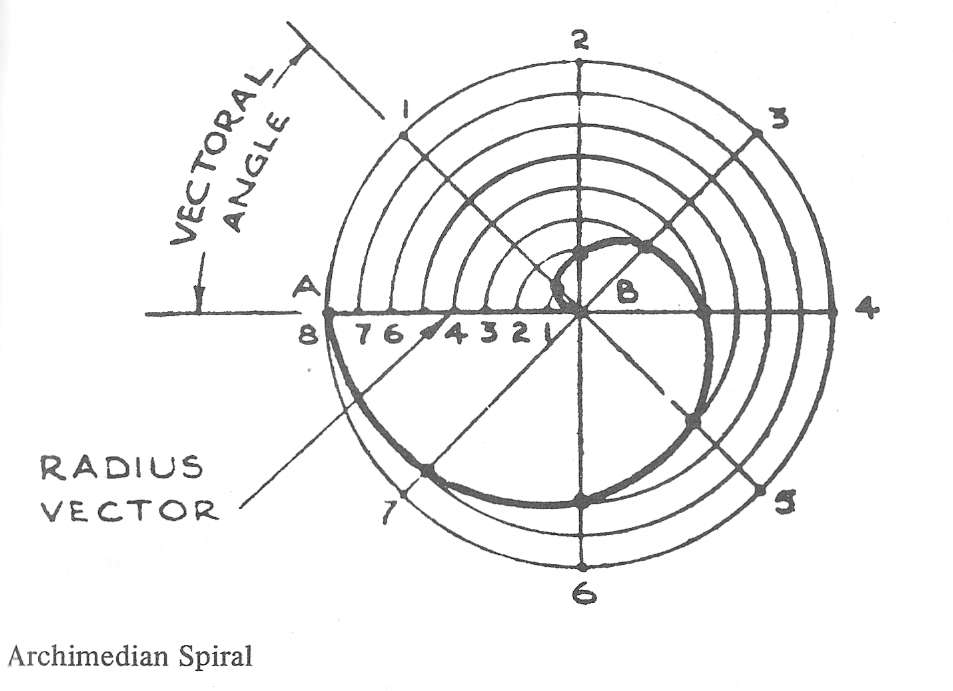

Huygens' Principle